The Evolving DNA of the Late goal: Volume, Variety, and Victors Across Europe's Top Five Leagues
Abhishek Vasu
Introduction
“Manchester City are still alive here. Balotelli. Agüerooooooo!”
The line, one of the most iconic in English football, was delivered by Martin Tyler to announce Manchester City’s late winner that won them their first Premier League title. This is a moment etched in the memory of many football fans. It is unlikely we will see a moment of such drama and magnitude ever again.
However, late goals are hardly uncommon in football. For teams like Manchester United in the 2000s, there was almost an expectation that they would score late on if they found themselves behind or level in a game.
In this piece, we look to analyse trends around late decisive goals using data from the top five leagues from the 2010/11 season through the 2025/26 season.
Some key questions include:
How important are late goals over the course of the season?
Has there been any change in late goal patterns over the years?
And, who are the biggest winners and losers when it comes to late goals?
Goal patterns
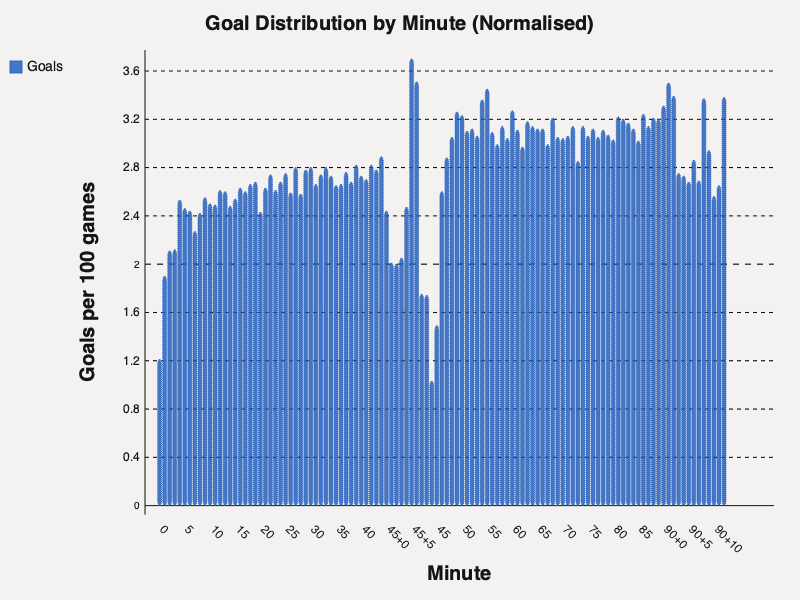
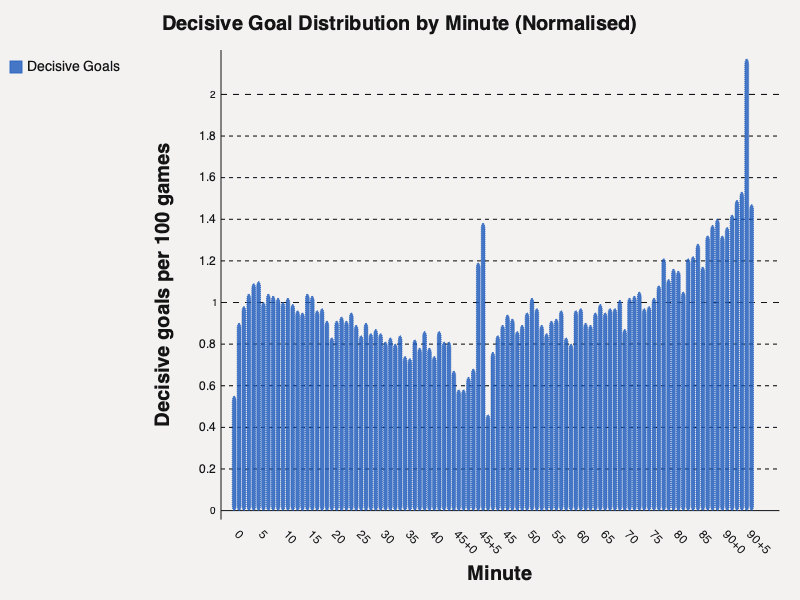
Before we dive deep into the analysis of late decisive goals, it is important to understand some basic patterns about goals and decisive goals. For this, we plot the distribution of goals and decisive goals by minute, normalised to account for the frequency with which any specific extra-time minute occurs (e.g. not every match has an eighth minute of stoppage time). This gives us an understanding of when a goal is likely to be scored, and if there is a difference in the distribution of a regular goal, and a decisive goal. For the purpose of this analysis, we define a decisive goal as one that changed the game state, either from a draw to a win or a loss to a draw.
The first plot, which depicts the distribution of all goals, shows us a few things. Firstly, we see that the likelihood of a goal being scored is slightly higher in the second half compared to the first. There is a slight spike in goals scored in first half stoppage time. On the other hand, in second half stoppage time, we see a drop in goals scored compared to the rest of the second half minutes.
The plot of decisive goals, however, tells us a different story. We see a spike in decisive goals in first half stoppage time. In the second half, we see the number of decisive goals increase as time increases, with there being large spikes in stoppage time yet again. The spikes in stoppage time are probably indications that pressure and tiredness combine to increase a team’s likelihood to concede a late decisive goal.
Trends in late decisive goals
We set a threshold of 85 minutes, and call any decisive goal scored after the 85 minute mark a late goal. In the plot below, we visualise the percentage of games in each season that contain a late decisive goal.
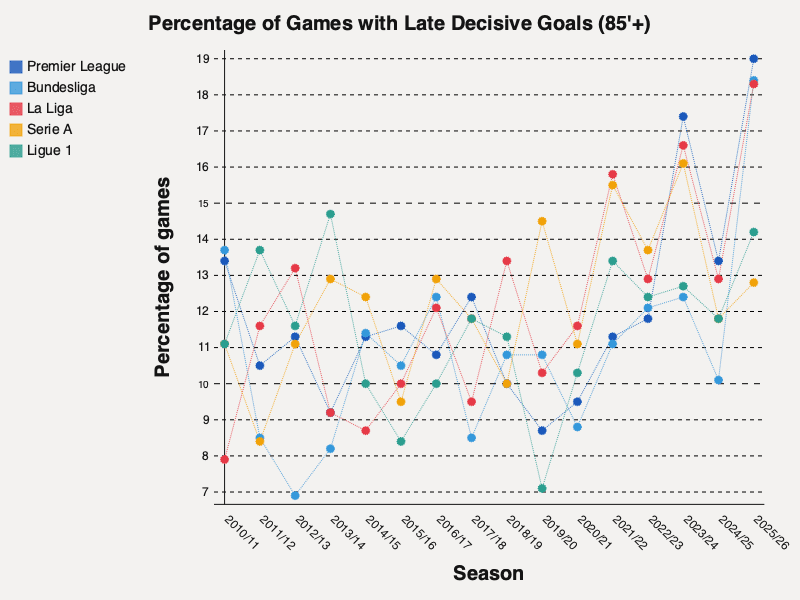
We notice an upward trend in the number of games containing late decisive goals from the 2019/20 season. By the 2025/26 seasons all the leagues contain a significantly higher number of games with late decisive goals. In the Premier league this season, one in five games is decided after the 85-minute mark.
Is this phenomenon because the games have become more exciting? Or is it a symptom of something else?
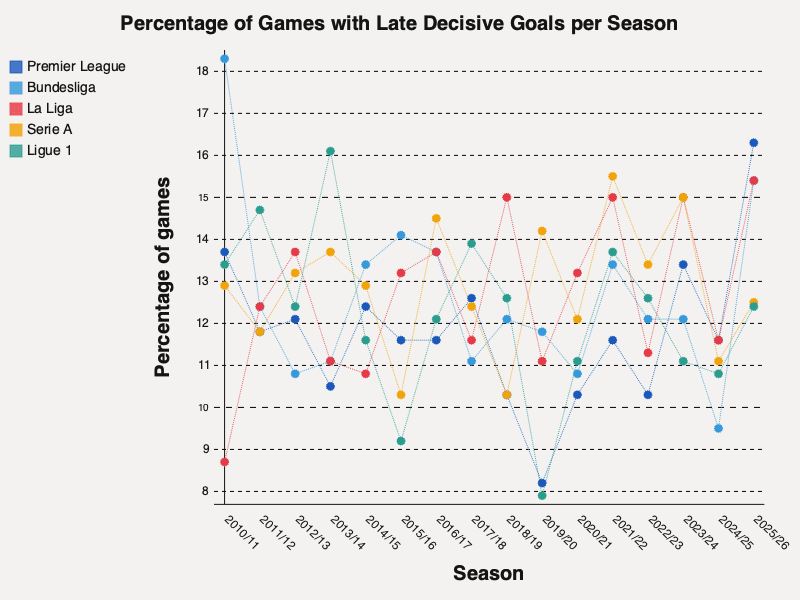
If we define a decisive late goal as a goal scored in the last 10% of a game, the trend starts to look a lot more flat. This is also supported by the fact that the average stoppage time at the end of the game has increased 86% since the 2010/11 season. The increase in the absolute number of decisive late goals, therefore, is largely a factor of the increase in the amount of extra time. This may not be a bad thing; as football fans, we love our drama and more opportunity for late-game heroics creates, well, more late-game heroics.
Who is scoring these late goals?
To answer this question, we want to analyse a team’s tendency to score late goals based on their strength. To do that, we classified each team into three categories - strong, mid and weak. The categorisation was based solely on the points they earned in that season. So, for example, Leicester City in the 2014/15 season are considered a weak team and in the 2015/16 season they are considered a strong team.
To begin with, we visualise the distribution of decisive late goals by team strength and also further break them down by the strength of the team they scored against.
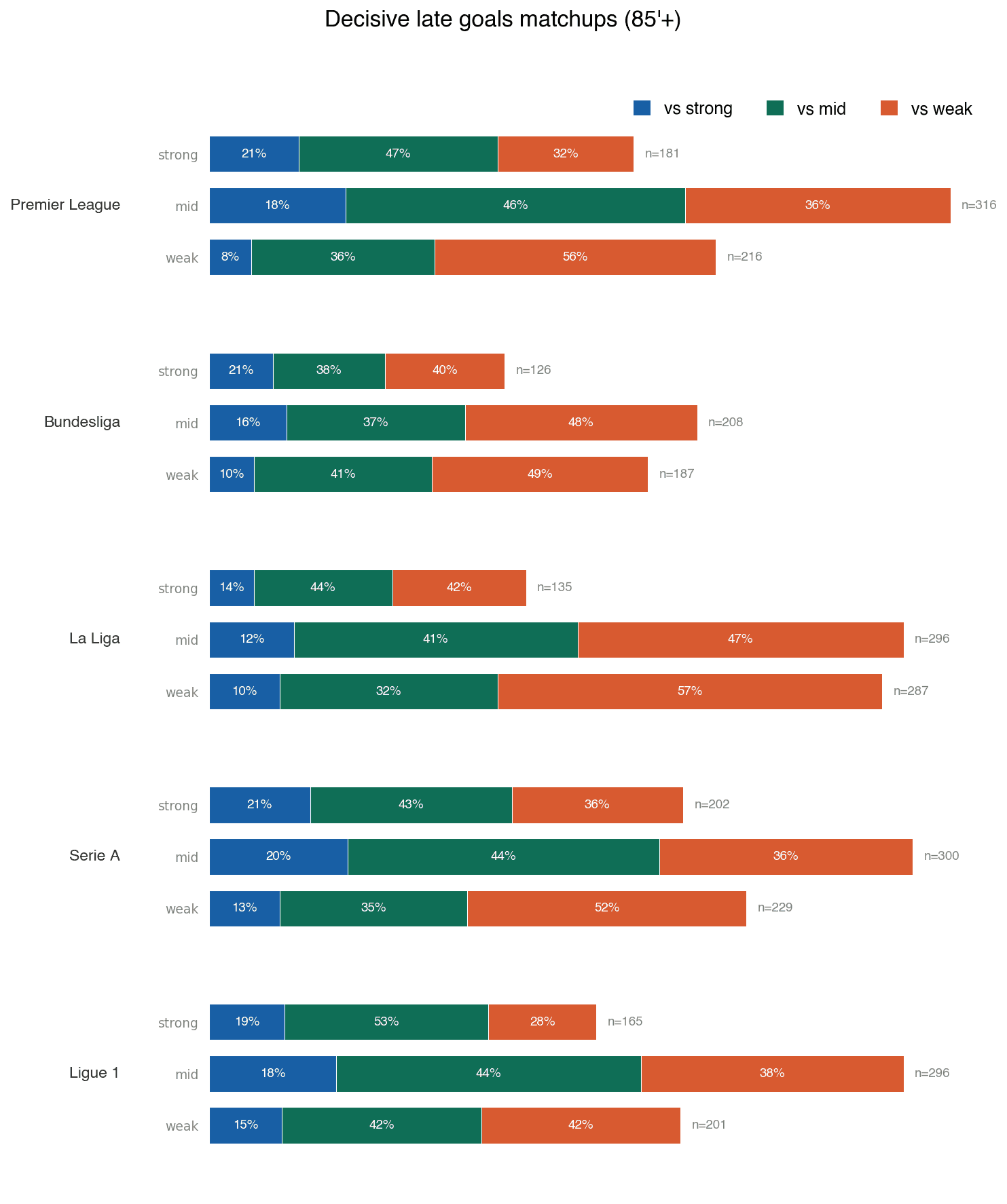
What sticks out is that the mid-tier teams score the most number of decisive late goals across all the leagues. La Liga presents an interesting case where the number of late goals scored by weak teams is very close to that of mid-tier teams. The strong teams across the board score the least number of decisive late goals. This can be explained by the fact that strong teams are usually in a good position come the end of the game.
To gain a true understanding of strong teams’ performance towards the end of games, we’d have to specifically look at instances where they were behind or level going into the final few minutes.
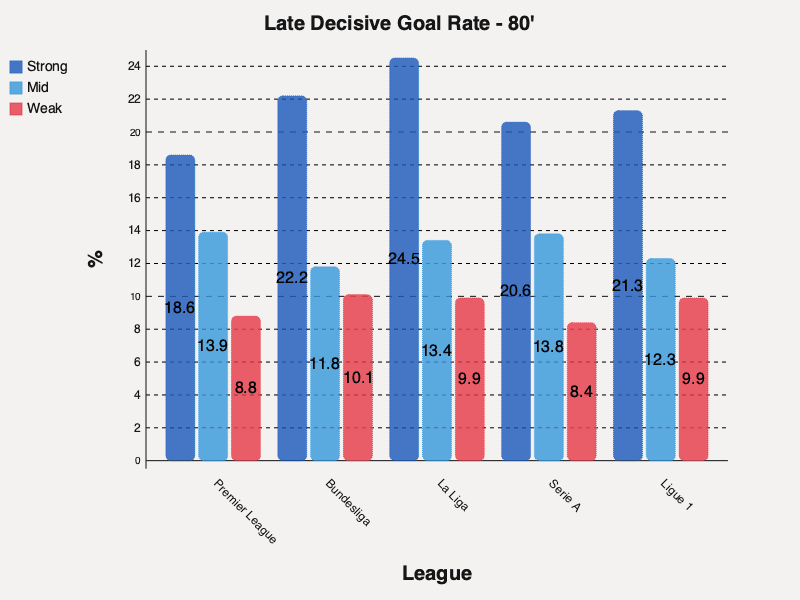
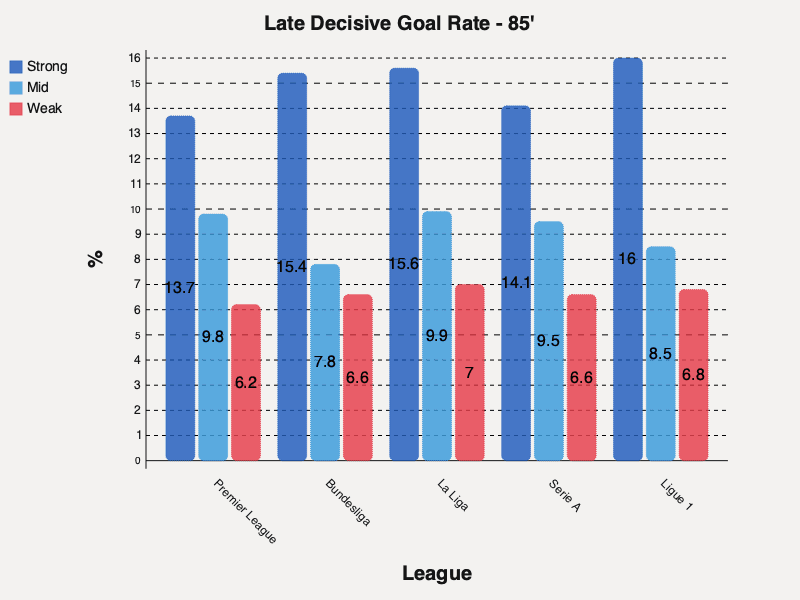
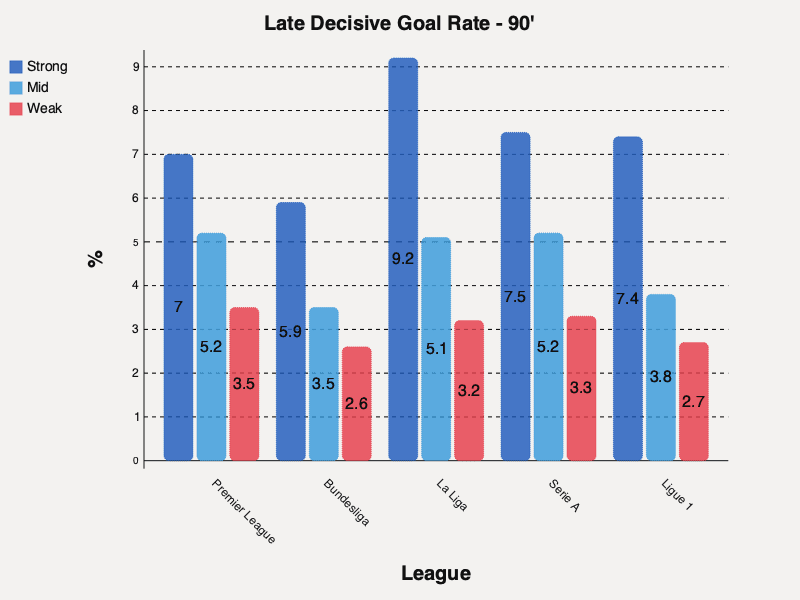
Now, here is where the strong teams shine. The strong teams in La Liga and the Bundesliga perform especially well. If we define a late goal as a goal scored after the 80th minute, we would expect a strong La Liga or Bundesliga team to score a decisive late goal every 4-5 games. Increasing the threshold to 85 minutes, and we would expect them to score a decisive late goal every 6-7 games. Increasing the threshold even further to 90 minutes, and the strong La Liga teams still do well with a 9.2% late decisive goal scoring rate.
What type of shots lead to late goals?
Before we investigate the type of shots that lead to decisive late goals, let us look at the types of shots that have led to all the goals in our chosen 16-year period. The distributions look fairly identical across leagues. Around 60+% of goals come from open play. The Premier league sees slightly more corner goals than the other leagues (the famous penalty-box wrestling may have something to do with this), but there isn’t too much of a difference. On the other hand, goals from penalties are slightly more common in La Liga and Serie A.
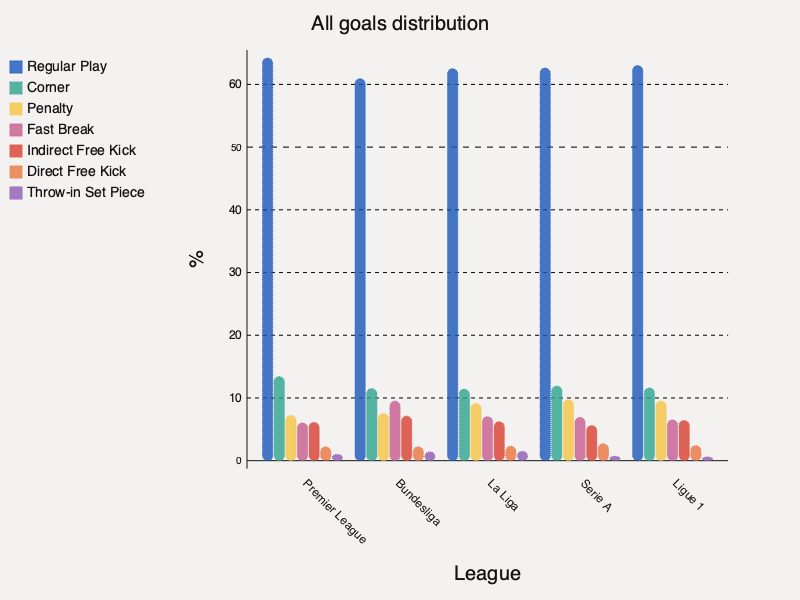
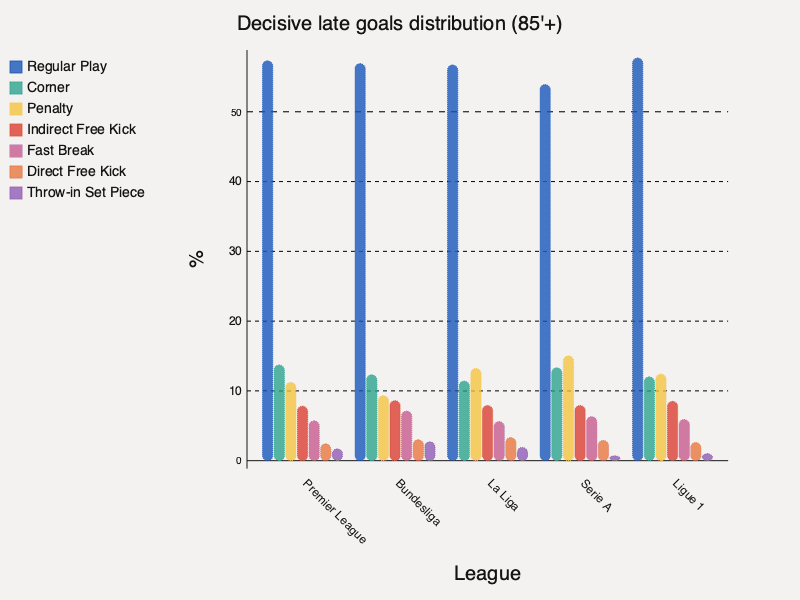
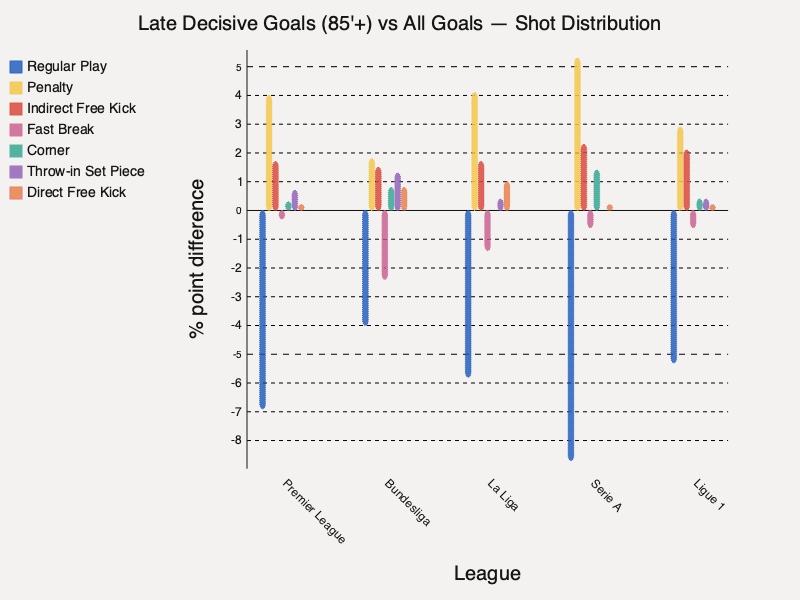
When we look at change over our time period, and, specifically, decisive late goals, we see that the goals from regular play are down across the board. On the other hand, late goals from penalties and indirect free kicks see a significant rise. Meanwhile, although goals from corners see an increase towards the end of the game, they do not deviate significantly from the norm.
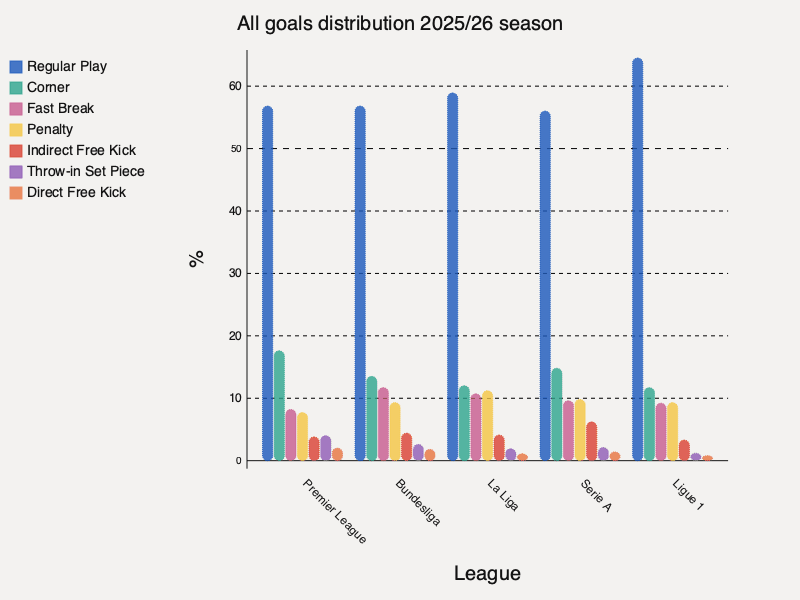
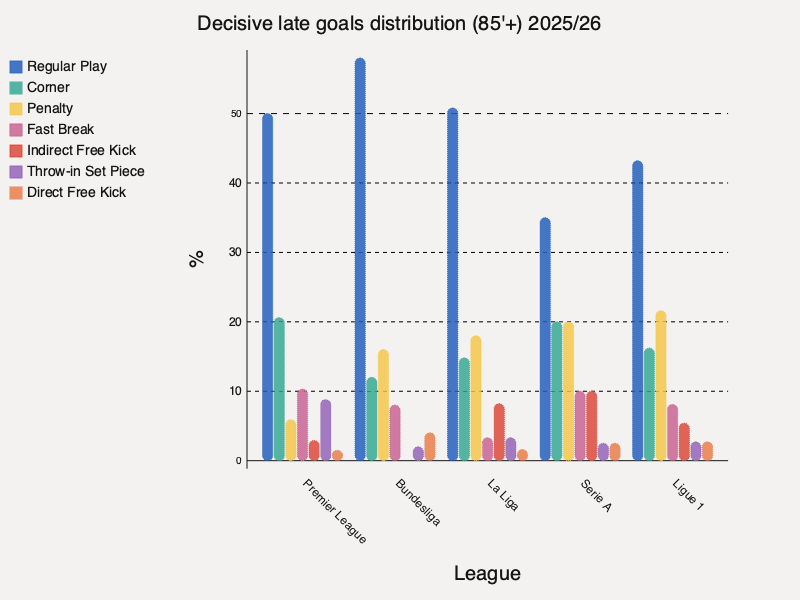
Zooming in specifically on the 2025/26 season, the distribution of all goals in this season sees a significant reduction in goals from regular play. Only Ligue 1 sees over 60% of goals scored from regular play, whereas the 16 season aggregate saw every league with 60%+ goals from Regular play. Goals from corners are up across the board compared to the 16 season aggregate. Inspecting late goals specifically, we see that the goals from regular play are down even further compared to all the goals scored during the season. Serie A and Ligue 1 see a 20 percentage point decrease, with penalties overly represented in decisive late goals.
Why is this happening? At this level of analysis, we can centre our speculation around a few potential explanations. The proliferation of set piece coaches in the Premier League is a natural starting point. As money and expertise has flowed into the game, it has tended towards greater efficiency and teams have been forced to search harder for marginal games, and areas like set pieces have become prime targets. The average number of corners per game in the Premier League is actually down 6.6% compared to the 16-season average. However, the number of goals scored from corners could potentially reach an all time high. Since corners have proven to be a profitable route to goal this season, it makes sense that teams would double down on them when they are in desperate need of a goal, when fatigue and pressure are high and the possibility for mental mistakes expands.
Penalties also present an interesting case. Across all 5 leagues this season, over 18% of the penalties are awarded after the 85th minute. This period of time, on average, represents about 10% of the game. This disproportionality could be explained by multiple factors - tiredness of body and mind, pressure on both players and referees, and the introduction of VAR increasing the chance that late-game mistakes will be caught. While the underlying causes remain a matter for further investigation, what is abundantly clear from our analysis is that the shape of the late goal is evolving away from open play and towards penalties and set pieces.
Shooting patterns
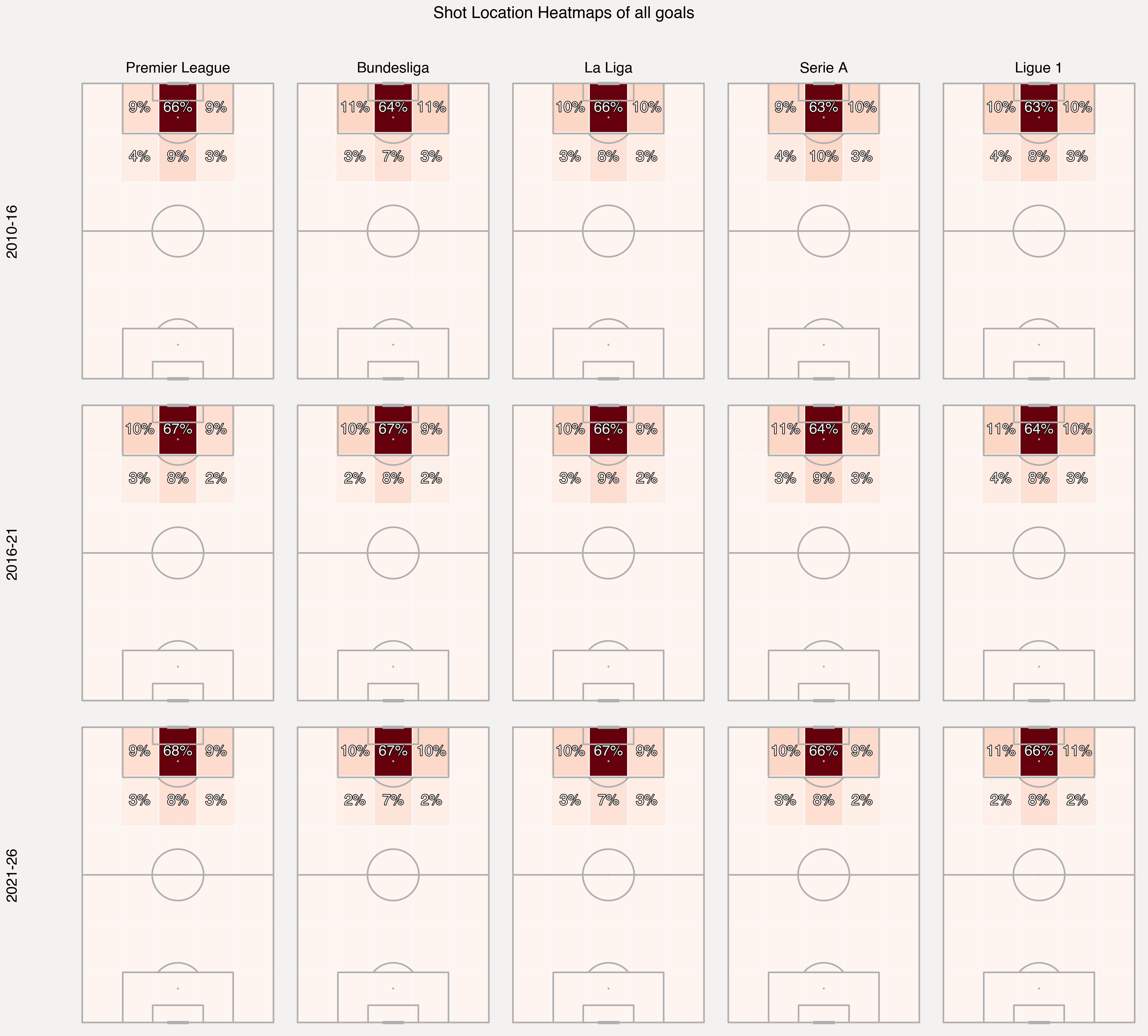
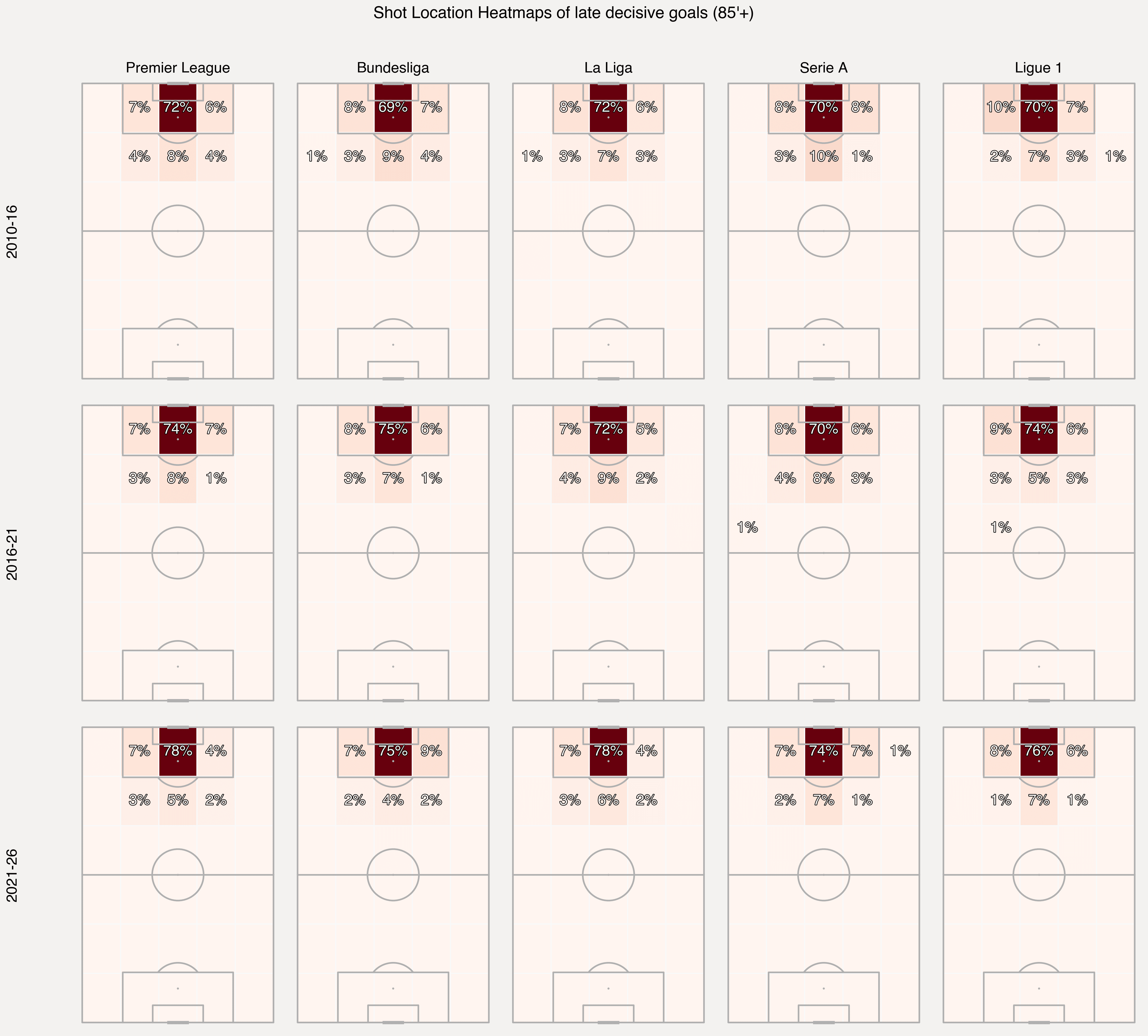
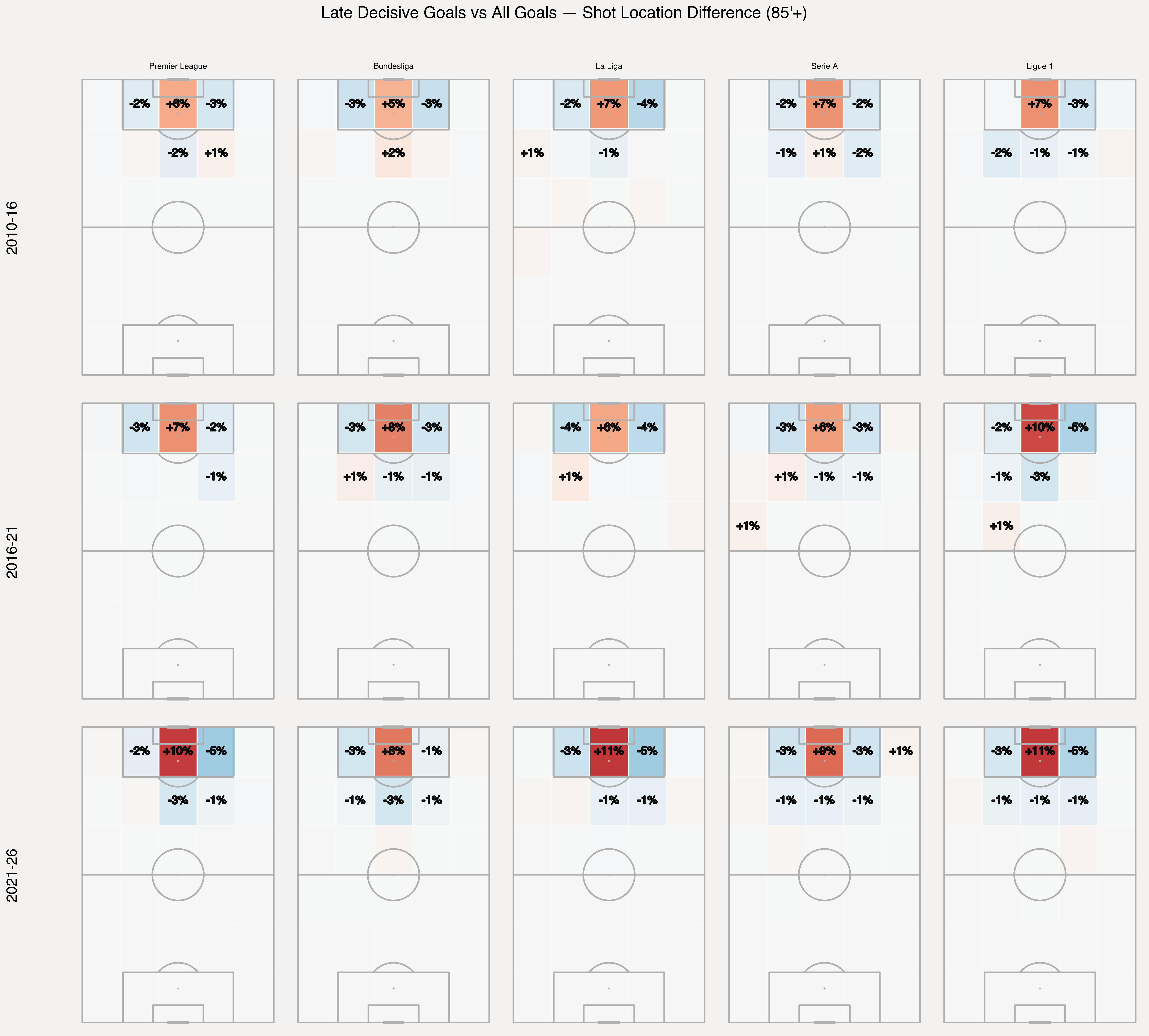
Looking at the shot maps for all goals scored, late decisive goals scored, and the difference between the two, we see a consistent pattern across all leagues, and all seasons. There are significantly more goals scored from central areas inside the box late in the game compared to the rest of the game. This also means that there is a drop in shots from distance. This is perhaps an indication that, late in games, teams would rather persist in trying to break the opposition down or trying to take advantage of set pieces, instead of taking speculative shots from distance. This phenomenon makes some intuitive sense; we’ve all seen the collective moan from a stadium crowd and a player’s team-mates when they miss the target with a speculative shot late on. Players are much more likely to be forgiven for such low-percentage efforts earlier in the game. Similarly, we’ve all seen teams throw big defenders forward and hoof the ball into the mixer late on — a tactic that inevitably produces more goals from inside the box than we would see at other times in a match.
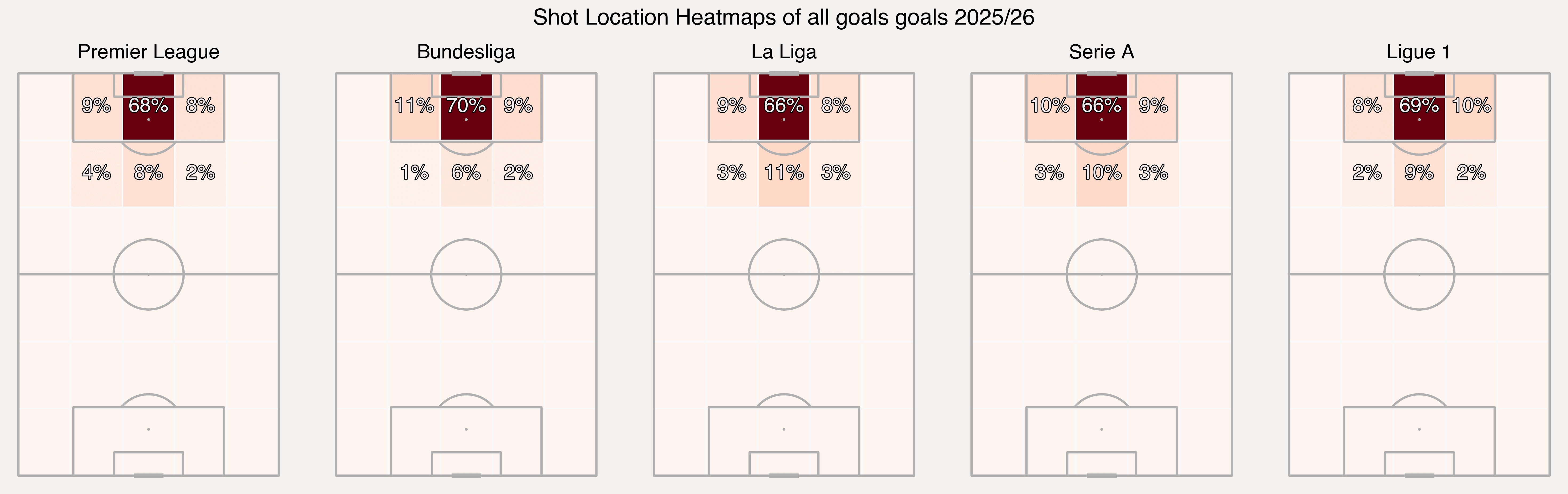
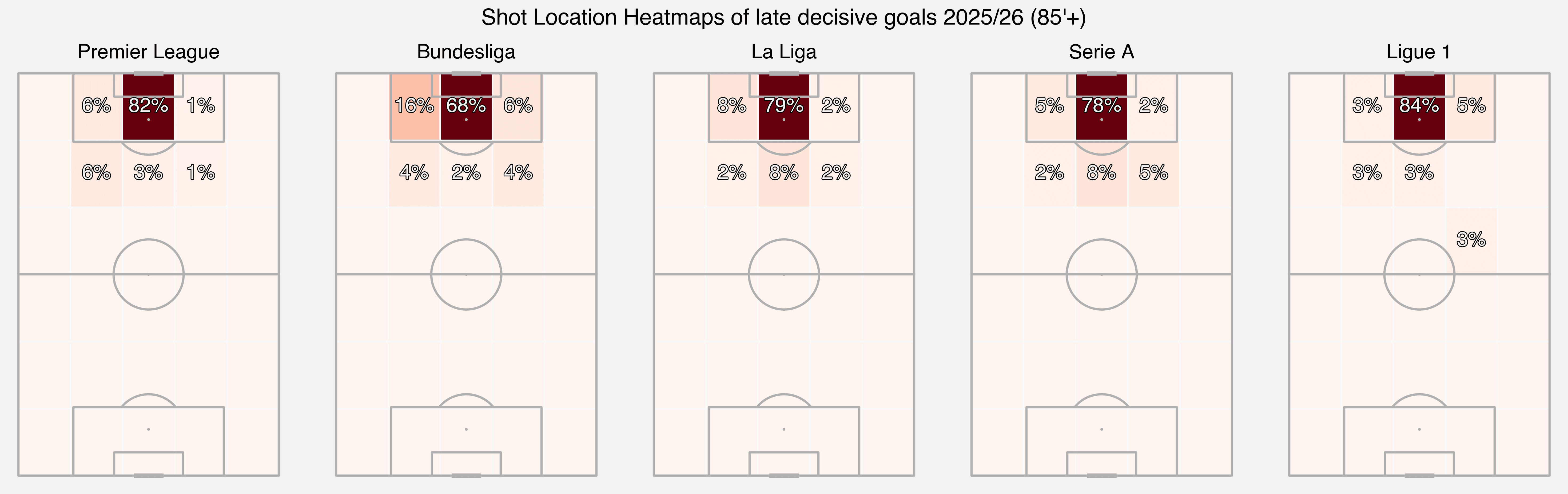
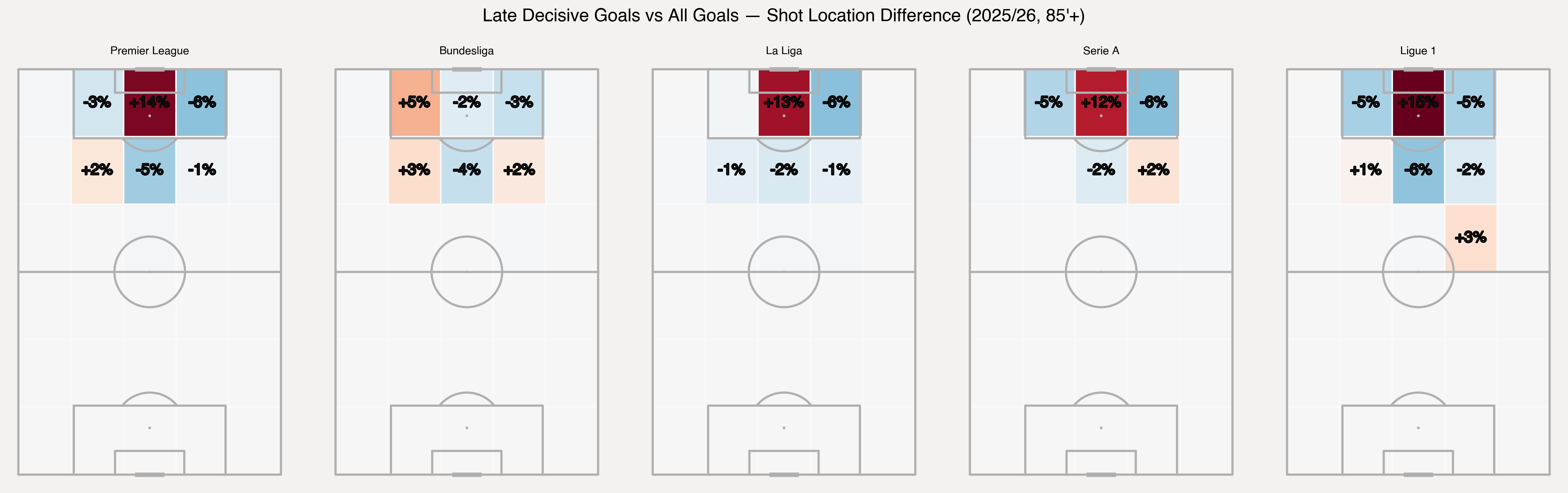
Zooming in specifically at the 2025/26 season, we see this trend continue for four of the five leagues. The Bundesliga is an anomaly here with surprisingly low numbers for goals from central areas in the box. However, the Premier League and Ligue 1 see more than four out of five late decisive goals coming from these areas.
What effect does this have on the league?
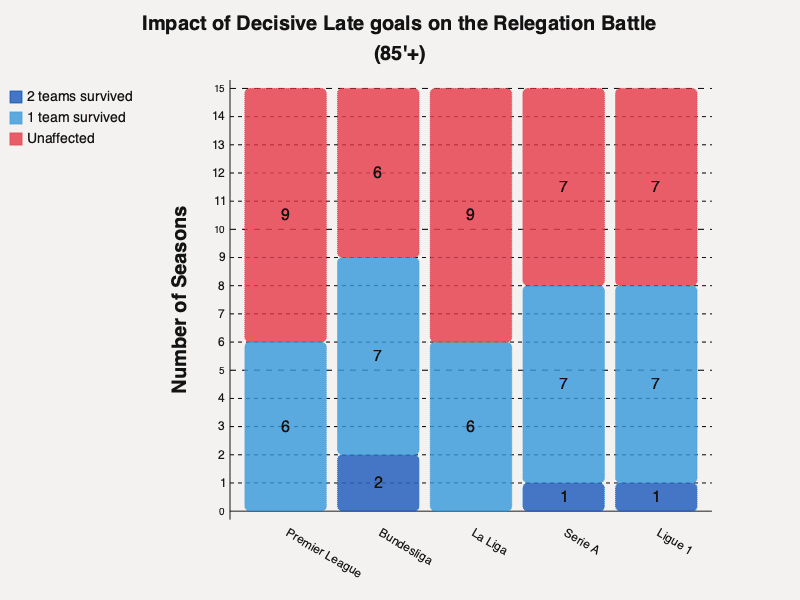
The final question that is left to be answered is arguably the most important one: what difference do these late goals actually make? We have heard numerous times that the mark of a champion is their ability to never give up and snatch a result when late on in games when their general play did not merit it. Sir Alex Ferguson’s Manchester United were famous for this. But do the points gained in this manner actually make a difference to the outcome of the league? Or is it more psychological? And what about at the other end of the table? Do late goals determine which teams get relegated?
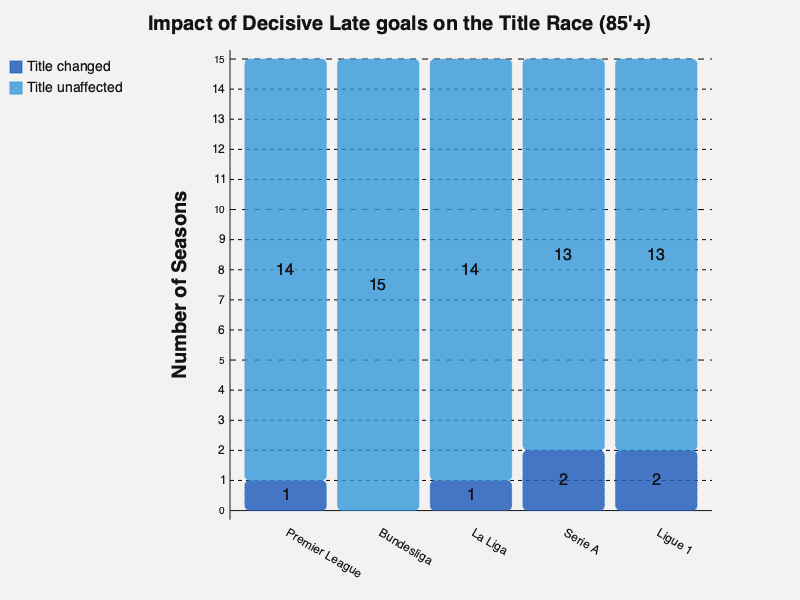
Unfortunately, from a title race point of view, we see that the late goals haven’t materially impacted the result. The title race in Bundesliga remains unaffected in every season (unsurprisingly, with Bayern typically running away with it). The Premier League and La Liga would have seen one out of the 15 seasons crown a different champion had it not been for decisive late goals, and Serie A and Ligue 1 would have seen two different winners
However, it is a different story down at the bottom. The Bundesliga is the most chaotic, where there are two seasons in which two of the teams would have survived if not for late goals. Serie A and La Liga see at least one relegated team survive every two seasons thanks to decisive late goals.
Conclusion
Witnessing a decisive late goal is one of the most enjoyable or disheartening experiences for a football fan. The number of late goals is on the rise, and with the increase in stoppage time due to injuries, concussion protocol, substitutions, and the “dark arts”, we will continue to be blessed by many such moments.
The football tactics landscape in the modern day is moving towards exploiting marginal gains, and creating high percentage chances. We see these trends for goals scored at any point during a game, and they are even more pronounced when it comes to decisive late goals.
Although we see that decisive late goals have changed the course of very few title races, teams that are fighting for the title are expected to score late winners and equalizers at a healthy rate. At the other end of the table, it is crucial for teams towards the bottom end of the table to avoid crumbling down in the final few minutes of the game.